Why is Bentonite One of the Most Widely Used Minerals?
برچسبها: Bentonite,Why is Bentonite One of the Most Widely Used Minerals?
Introduction to the Mineral Bentonite and Its Importance in Industry
Minerals have always played a fundamental and key role in the development of various industries, and among them, bentonite is recognized as one of the most functional and amazing geological compounds. This material consists of clay primarily containing smectite minerals, especially montmorillonite. The unique physical and chemical properties of this material make it an irreplaceable option in various industrial fields. Understanding why this material is popular requires a careful examination of its structure, swelling properties, and water absorption.
Focusing on the standard extraction and processing of minerals, the Amiran Stone Mineral Project supplies and distributes this product within a mesh range of 200–450 mesh so that various industries can achieve the best efficiency from it. Precise knowledge of this material helps engineers and industrialists optimize their production processes. To learn more about specialized products and view technical details, you can visit the bentonite page, which is recognized as a complete reference for supplying this material.
In addition, examining the role of other minerals such as feldspar in various industries gives us a more comprehensive perspective on the importance of industrial geology; a useful article in this regard titled Why Feldspar is One of the Most Important Minerals in Industry provides valuable supplementary information. In the following sections of this article, we will examine the technical dimensions and precise applications of this material in drilling fluids, casting, and absorbent and binder materials.
Structural Analysis and Physical and Chemical Properties of Bentonite
Understanding the internal structure of bentonite is the key to understanding why it is widely used in heavy industries. This material is a type of fine-grained clay formed from the weathering of volcanic ash in the presence of water. Its crystal structure consists of octahedral silicate and aluminate layers, the interlayer spaces of which have the ability to absorb water molecules and various ions. This structural feature causes its volume to increase sharply after coming into contact with water, creating stable and cohesive suspensions.
The granulation and meshing of this material have a direct impact on its efficiency. This product is processed with a mesh range of 200–450 mesh, providing an active and suitable surface for physical and chemical reactions. The stability of this material under various industrial conditions is a topic also addressed in the material engineering literature; for example, the article The Role of Bentonite in Improving the Stability of Mineral and Industrial Materials closely examines the stabilizing mechanisms of this material.
Furthermore, international research has also investigated these features, and studying the Arabic article دور البنتونیت في تحسين استقرار المواد المعدنية والصناعية reveals other dimensions of the stabilizing applications of this material. The variety in meshes from 200 to 450 allows industrialists to choose the best grading degree based on the exact needs of their project.
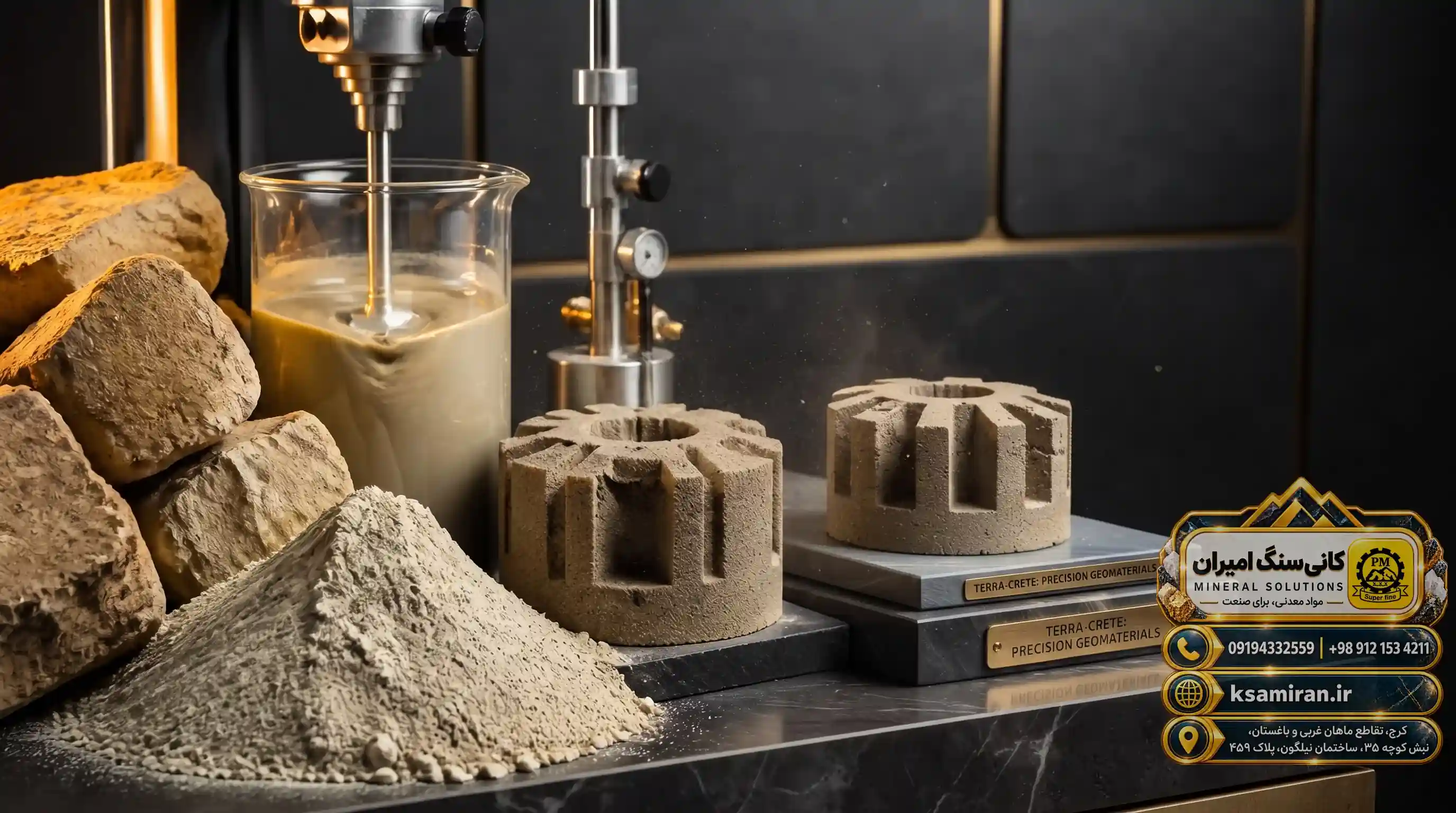
Application of Bentonite in Drilling Fluids and Well Engineering
One of the most important and vital industrial applications of bentonite is its use in the formulation of drilling fluids and drilling muds. In oil, gas, and water well drilling operations, drilling mud performs multiple tasks including bit cooling, transporting rock fragments to the surface, and stabilizing the wellbore. Colloidal properties and the ability to create suitable viscosity in water make this material the primary additive for adjusting viscosity and controlling fluid loss.
When this material is mixed with water, it forms a gelatinous network that can keep suspended drilling particles at rest and prevent them from settling on the drill bit. The 200–450 mesh range supplied by Amiran Stone Mineral ensures that the particles hydrate at an appropriate speed and form a homogeneous and high-quality drilling mud. This feature dramatically reduces drilling operational costs and increases project safety.
Drilling engineers are always looking for compounds that maintain their stability against high pressures and variable well temperatures. Due to its thixotropic property (gel-forming at rest and fluid-forming under shear), the use of this mineral is considered a standard and economical option worldwide that guarantees the optimal performance of drilling rigs.
The Role of Bentonite in Casting and Molding Industries
The foundry industry is another field where bentonite plays a vital role. In green sand molding processes, this material is used as the primary binder for foundry sand. Green foundry sand requires a material that can bond sand grains together and provide the necessary mechanical strength to withstand the pressure of molten metal without disrupting gas permeability.
The extraordinary adhesion and plasticity of this material ensure that sand molds have excellent formability and easily separate from the part after hot metal casting. The mesh range of 200–450 mesh is ideal for the uniform distribution of the binder among the sand grains. This results in a smoother final surface of cast parts produced without structural defects such as cracking or gas cavities.
The use of quality casting products relies on the purity and grain size characteristics of the consumed minerals. By providing this material with specified physical standards, industrial suppliers help casting factories improve the quality of their final products and minimize production waste.

آدرس: کرج تقاطع ماهان غربی و باغستان نبش کوچه ی 35 ساختمان نیلگون پلاک459
تلفن ۱: 0912 153 4211
ایمیل: amiran.kani.sang@gmail.com
Applications of Bentonite as an Absorbent and Purifying Material
High surface adsorption capacity makes bentonite one of the most efficient absorbent materials in various industries. The porous structure and high surface area of the particles of this material allow it to absorb large amounts of liquids, ions, and organic or mineral compounds. This feature is widely used in industrial wastewater treatment, bleaching of edible and industrial oils, and the production of moisture and odor-absorbing beds.
In purification and separation processes, this material is able to adsorb impurities and undesirable pigments and remove them from the system through filtration processes. The mesh range of 200–450 mesh creates very suitable contact surfaces for performing adsorption reactions, which significantly increases process efficiency. This absorbent property is also used in the pharmaceutical and agricultural industries as a carrier for poisons or active ingredients.
Using natural absorbents like this product is not only economically viable, but due to its environmental friendliness, it is considered a suitable alternative to synthetic chemicals. The ability to absorb moisture and odor has led to high demand in the production of products such as pet litters and industrial absorbents.
Application of Bentonite as a Binder in Various Industries
In addition to casting, the role of bentonite as a powerful binder is prominent in many other industries as well. In the production of iron ore pellets (pelletizing), this material acts as a binder that turns iron concentrate into wear-resistant pellets so they do not disintegrate in iron smelting furnaces. Furthermore, its adhesive properties are utilized in animal feed production, ceramics, and building materials manufacturing.
The binding capability of this material stems from electrostatic forces between clay particles and water molecules, which, after drying, create a strong and continuous network. The mesh range of 200–450 mesh helps distribute the binder homogeneously throughout the entire mass volume, preventing weak points in the final product structure. This drastically increases the mechanical strength and thermal stability of products.
Manufacturing industries are always looking for quality raw materials that facilitate the pressing and shaping process. By supplying this product with precise technical specifications, the Amiran Stone Mineral Project has well met the need of various industries for high-quality mineral binders and elevated production standards.
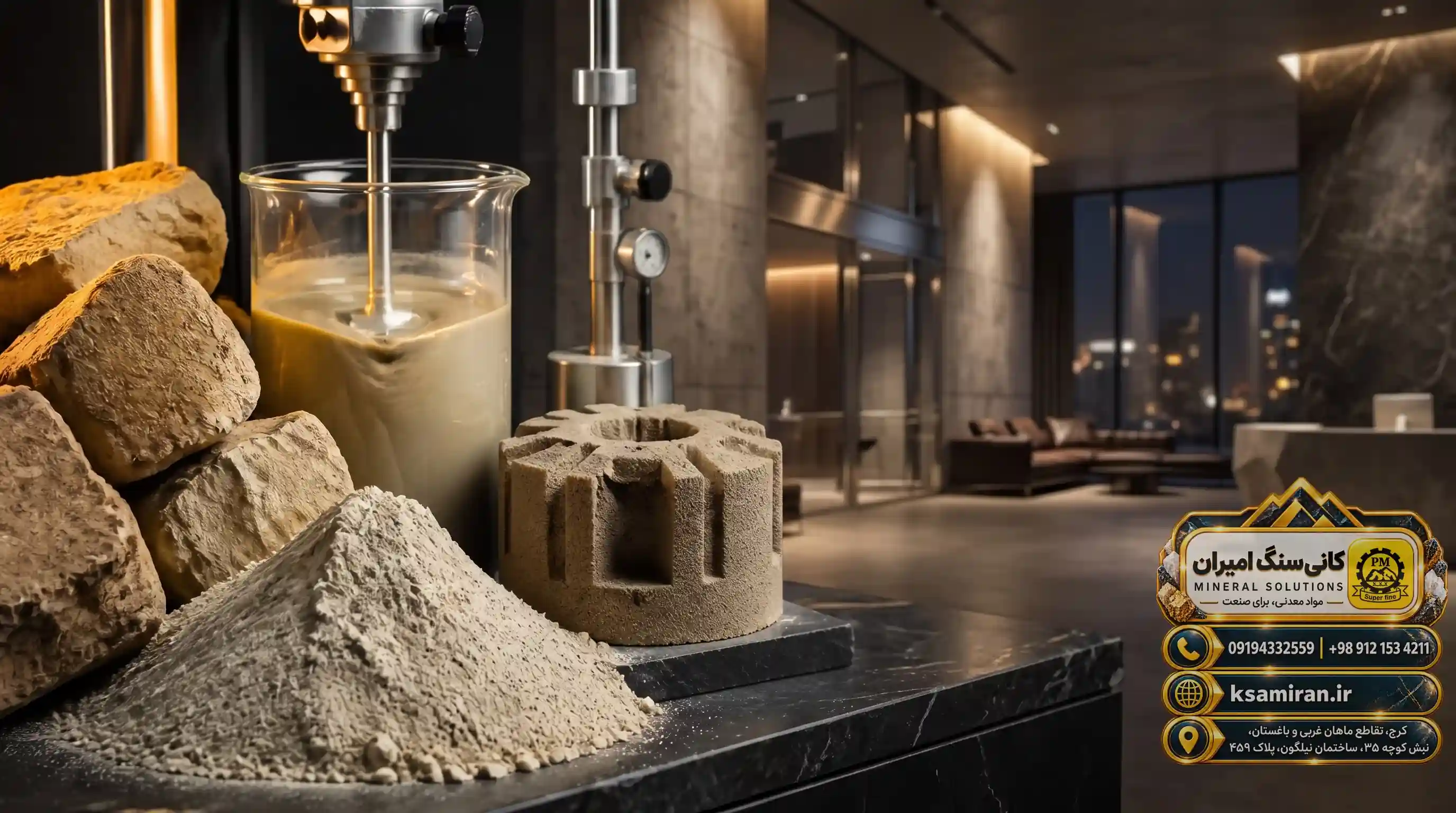
Processing, Granulation, and Quality Control of Bentonite
Converting raw ore into standard bentonite powder requires precise industrial processes and continuous quality control. Production stages include mining, primary crushing, controlled drying to reduce moisture, and finally grinding in modern equipment to achieve the mesh range of 200–450 mesh. Precise particle size control within this mesh range is vital to ensure uniform product performance in drilling and casting industries.
Various laboratory tests such as measuring Cation Exchange Capacity (CEC), swelling capacity, determining pH, and measuring moisture percentage are performed on the final product to ensure its compliance with industrial standards. Precision in the granulation stages ensures that the final product lacks coarse impurities and easily hydrates and disperses in industrial systems.
Utilizing advanced processing equipment and experienced experts, the Amiran Stone Mineral Project supplies a high-quality product to the market. Supervision of the supply chain from the mine to warehousing ensures that industrial buyers always have access to a stable material with uniform technical specifications.
Market Outlook and Economic Benefits of Using Bentonite
The global and domestic markets for bentonite have always been growing due to widespread applications in strategic industries. The relative abundance of this material in nature, combined with economical mining and processing costs, makes it one of the most popular minerals for purchasing managers and production engineers. Optimal use of this material can noticeably reduce final production costs in industries such as casting and drilling.
Infrastructure development, the increase in construction projects, and the advancement of the metallurgy, oil, and gas industries have increased the demand for this mineral in recent years. Domestic producers have been able to minimize the country's industry need for foreign suppliers and strengthen industrial independence by continuously supplying products with a mesh range of 200–450 mesh.
Ultimately, choosing a reputable supplier plays an important role in the success of industrial projects. By providing transparent information and easy access to products through its official website, the Amiran Stone Mineral Project has provided conditions for various industries to confidently proceed with supplying their mineral needs and maximize their operational efficiency.
| Question | Answer |
|---|---|
| What is bentonite? | It is a type of fine-grained clay with high swelling and water absorption properties that has numerous industrial applications. |
| What is the mesh range of this product? | This product is processed and supplied in a mesh range of 200–450 mesh. |
| What are the main applications of bentonite? | Drilling fluids, casting products, absorbents, and binders are its main applications. |
| Why is this material used in drilling fluids? | It is used in drilling mud due to its viscosity generation, wellbore stability, and excellent gelling properties. |
| What is the role of bentonite in casting? | It acts as a binder for molding sand and increases the mechanical strength of the mold. |
| How does it act as an absorbent material? | It has a porous structure and high surface area to absorb liquids, ions, and impurities. |
| Is this material suitable for pelletizing industries? | Yes, it is used as a binder in the production of iron ore pellets. |
| What services does the Amiran Stone Mineral Project offer? | This collection is a producer and supplier of high-quality and standard minerals. |
| How can this product be obtained? | You can proceed by visiting the dedicated product page on the Amiran Stone Mineral website. |
| What is the economic advantage of using this material? | Natural abundance, high efficiency, and reduction of final production costs in various industries are among its advantages. |
Amiran Stone Mineral Project, comprehensive guide to mineral and industrial materials.
- ۰ ۰
- ۰ نظر